
How to Build a DEI Ambassador Programme That Lasts
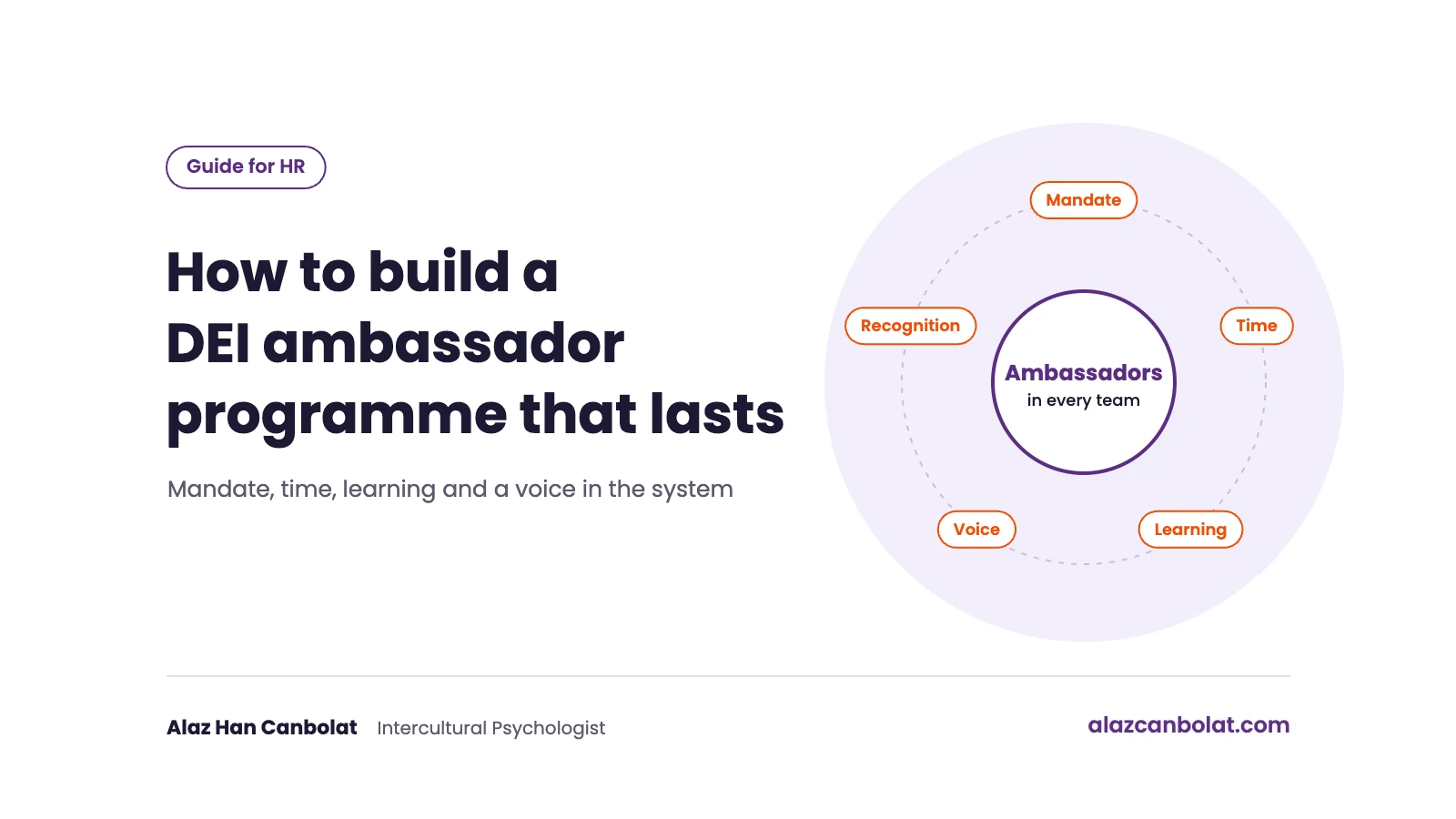
Short answer: A DEI ambassador programme works when ambassadors have a clear mandate, protected time, a learning journey rather than a one-day kick-off, and a direct line to the people who own policy. Without these, it turns into an events committee run on goodwill, and goodwill runs out.
Many organisations reach the same point in their inclusion work. Leadership is on board, a few trainings have been delivered, and now the question is: “How do we make this live in every team, not just in HR’s calendar?”
The usual answer is an ambassador network. A group of volunteers, a launch event, a Teams channel.. And six months later, the same five people are organising the same three events while the rest of the network has gone quiet.
In this article I share why ambassador programmes stall, five design decisions that make them last, and how to tell whether yours is working.
Why ambassadors? Because people learn from people
Albert Bandura showed in 1977 that we learn much of our behaviour by watching others, especially people we see as similar to us. Everett Rogers’ work on the diffusion of innovations (1962) points the same way: new practices spread through trusted peers and opinion leaders, not through memos.
For inclusion, this matters. A manager may forget the slide about inclusive meetings. They are far less likely to forget the colleague in their own team who, every week, makes sure the quietest person gets the floor.
Research on diversity programmes supports this direction too. Frank Dobbin and Alexandra Kalev (2016) reported that mandatory diversity training on its own often fails to move the numbers, while approaches that engage people, such as mentoring, task forces and voluntary programmes, tend to do better. An ambassador network is one of those engagement structures, if it is designed as one.
Where ambassador programmes go wrong
📌 No mandate. Ambassadors are asked to “promote inclusion” but have no defined role, no decision rights and no one to escalate to. They become cheerleaders without a playbook.
📌 No time. The work is added on top of a full job. In 1994 Amado Padilla named this pattern “cultural taxation”: people from under-represented groups are repeatedly asked to do diversity work that is neither recognised nor rewarded. Ambassador programmes can quietly reproduce it.
📌 Events instead of practice. Awareness days and panel talks are visible and easy to count. But they rarely change what happens in a Monday team meeting.
📌 No line to the system. Ambassadors hear what employees experience, but there is no channel to bring it back to the people who write the policies. The insight stays in the channel chat.
5 design decisions for a programme that lasts
1. Write the mandate before you recruit
Define three to five things an ambassador does, in plain language. For example: runs one inclusive practice in their own team, collects anonymous feedback once a quarter, and joins a monthly learning circle. Recruit against the role, not against enthusiasm alone.
2. Protect the time and make it visible
Agree a realistic time allocation with line managers before the programme starts, and write it into objectives. If the work does not appear anywhere in performance conversations, people will rightly treat it as optional.
3. Design a learning journey, not a launch day
Ambassadors need more than motivation. They need skills: facilitating difficult conversations, noticing exclusion in everyday moments, responding when someone speaks up. That takes practice spread over weeks, with peers to reflect with.
4. Connect ambassadors to policy and practice
In the 3P Inclusive Culture Model™ I look at three layers together: policy (what is written), practice (what people actually do) and perception (what employees experience). Ambassadors sit naturally in the practice and perception layers. Give them a regular, structured way to feed what they see back to the people who own policy.
5. Recognise the work
Recognition does not have to be expensive: a line in the annual review, visibility in leadership meetings, a development opportunity. What matters is that ambassadors are not doing invisible labour.
How do you know it’s working?
Count activities if you like, but don’t stop there. Look for change in the teams the ambassadors are part of.
| Area | Indicator | When? |
|---|---|---|
| Practice | Share of ambassadors running at least one inclusive practice in their own team | Monthly |
| Climate | Team-level psychological safety and belonging, measured with the same questions | Before the programme and after 6 months |
| Voice | Number of issues raised through ambassadors that reached a policy owner, and how many got a response | Quarterly |
| Sustainability | Ambassador retention and self-reported workload | Every 6 months |
If you need a starting point for the climate measure, my guide on how to measure psychological safety walks through a short team-level survey step by step.
How J-EDI Master structures an ambassador programme
J-EDI Master, my Inclusive Culture Ambassador Programme, is built around these five decisions. It starts with three days of face-to-face, experiential training, followed by online learning circles and six weeks of micro-learning with short readings and small tasks ambassadors try in their own teams. A progress board and light gamification keep the cohort moving together, and the 3P lens gives ambassadors a shared language to bring what they see back to HR.
In short: Ambassadors are not a shortcut to an inclusive culture. They are a structure. Give them a role, time, skills and a voice in the system, and they become one of the most effective ways to make inclusion part of everyday work.
Frequently asked questions
Should a DEI ambassador role be voluntary?
Yes, joining should be voluntary, but the role itself should not be informal. Volunteers bring energy; a clear mandate, protected time and recognition are what keep that energy from burning out.
How many ambassadors do we need?
There is no magic ratio. A practical rule is to start with a cohort small enough to learn together in one room and spread across the teams where you most want to see change. Grow the network once the first cohort is running practices in their own teams.
Is an ambassador network the same as an employee resource group?
Not quite. Employee resource groups usually bring together people with a shared identity or experience. An ambassador network is a cross-cutting role focused on everyday inclusive practice in every team. The two work best when they talk to each other.
Where to start?
If you are planning an ambassador network for 2027, we can start with a one-hour webinar for your HR team to map the mandate, time and measures before you recruit. Book a 30-minute discovery call, or use the proposal form to tell me what you need, and I’ll get back to you within 24 hours.
Who are the people in your organisation others already watch to learn “how things are done here”?
Best wishes,
Alaz Han
References
- Bandura, A. (1977). Social learning theory. Prentice Hall.
- Dobbin, F. and Kalev, A. (2016). Why diversity programs fail. Harvard Business Review, 94(7), 52–60.
- Padilla, A. M. (1994). Ethnic minority scholars, research, and mentoring: Current and future issues. Educational Researcher, 23(4), 24–27.
- Rogers, E. M. (1962). Diffusion of innovations. Free Press.

Has worked with 300+ organisations and projects in 60+ countries; served as a learning and development consultant at the UN World Food Programme. About me