
Inclusive Leadership Training for Managers: What HR Should Ask For and Measure
Short answer: Good inclusive leadership training for managers focuses on a few observable behaviours, gives managers time to practise them in real meetings, follows up over 30 days and measures change at team level. If a programme can’t tell you which behaviours it targets and how it will measure them, it is an awareness session, not leadership development.
“Inclusive leadership” appears in more and more competency models. Which is great.. until someone asks what it actually looks like on a Tuesday afternoon in a project meeting.
This guide is for HR and L&D teams choosing or designing an inclusive leadership programme for managers. It covers what inclusive leadership means in research, why manager training often doesn’t stick, five questions to ask any provider, and what to measure.
What is inclusive leadership?
Lynn Shore and colleagues (2011) describe inclusion as the combination of two needs: belonging (I am accepted as part of the group) and uniqueness (I don’t have to hide what makes me different). An inclusive leader meets both at the same time.
Ingrid Nembhard and Amy Edmondson (2006) studied this in healthcare teams. They defined leader inclusiveness as words and deeds that invite and appreciate others’ contributions, and found it was linked to higher psychological safety, especially for team members with lower status.
Deloitte’s Juliet Bourke and Bernadette Dillon (2016) summarised six traits often seen in inclusive leaders: commitment, courage, cognisance of bias, curiosity, cultural intelligence and collaboration. Useful as a map. But traits are hard to train. Behaviours are not.
Why manager training often doesn’t stick
📌 Managers already “know”. Most managers agree that inclusion matters. The gap is between knowing and doing under pressure, when the deadline is tomorrow and the loudest person in the room has an opinion.
📌 One day, then nothing. A single workshop can open the door. Without follow-up, the new behaviour fades within weeks. I wrote about the research behind this in why unconscious bias training alone is not enough.
📌 Values instead of behaviours. “Be open and respectful” is not something you can practise or observe. “Ask for the view of someone who hasn’t spoken before you share yours” is.
5 questions to ask before you buy an inclusive leadership programme
1. Which behaviours will change?
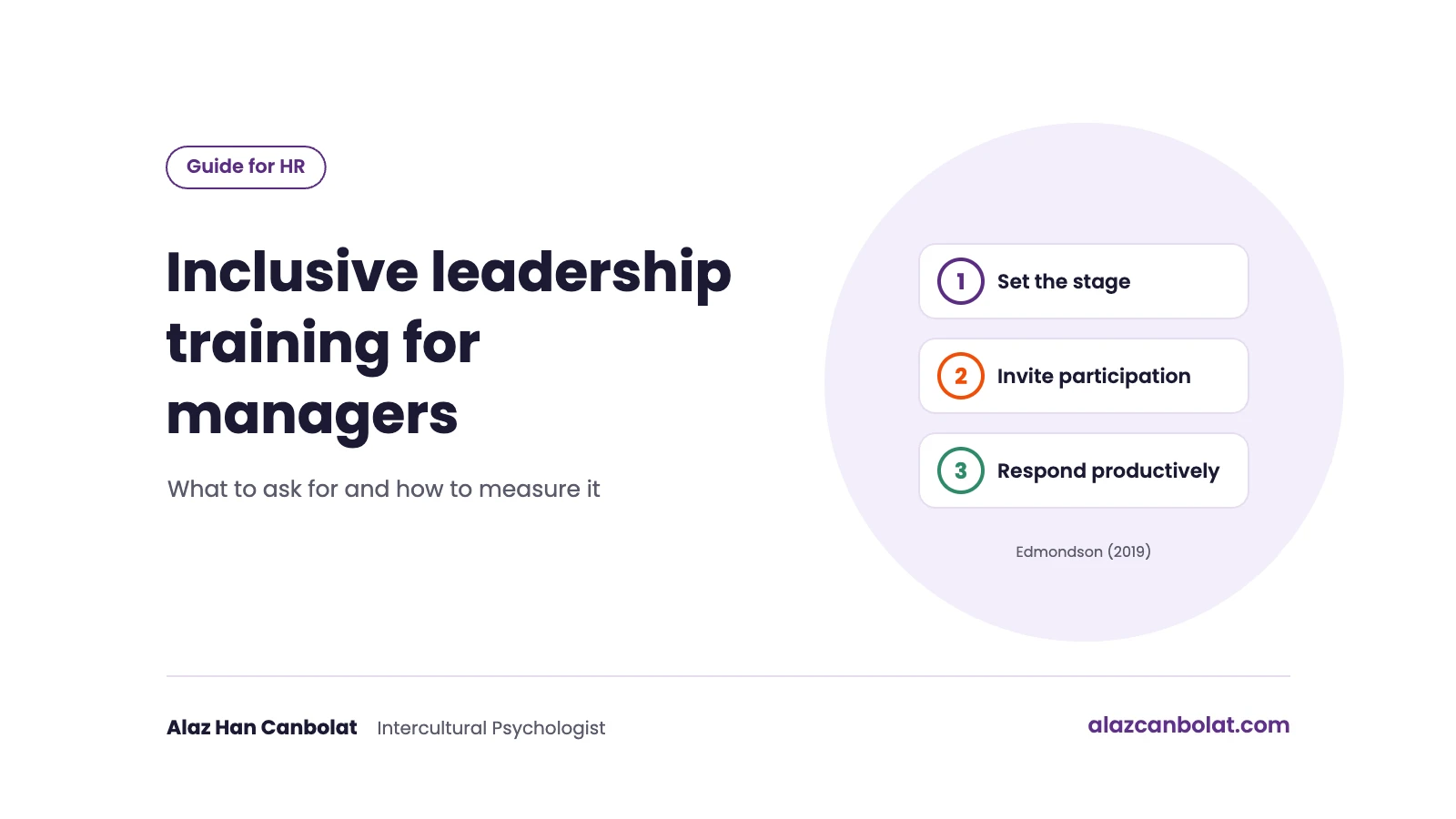
Ask for three to five specific, observable behaviours. Edmondson’s (2019) three leadership moves are a good test: setting the stage (making clear that input is needed), inviting participation (asking genuine questions, making space) and responding productively (thanking, being curious, following up).
2. Where will managers practise?
The best practice ground is the manager’s own team meetings, one-to-ones and decisions. Look for programmes that give managers a small, real task to try the week after the workshop.
3. What happens after the workshop?
Short check-ins on days 7, 14 and 30, peer learning circles or a follow-up session. Something that keeps the behaviour alive while it becomes a habit.
4. How is it connected to the system?
If meeting formats, promotion criteria or feedback processes reward the opposite behaviour, training will lose. Ask how the programme looks at policy and practice, not only at individual mindsets.
5. How will we know it worked?
Satisfaction scores tell you whether people enjoyed the day. You need behaviour and team climate data.
What to measure
| Area | Indicator | When? |
|---|---|---|
| Behaviour | How often managers apply their chosen behaviours (self-report + short team pulse) | Days 7, 14 and 30 |
| Meetings | Distribution of speaking time; how often differing views are voiced | Before the workshop and on day 30 |
| Climate | Team-level psychological safety and belonging, with the same questions | Before and 3–6 months after |
| Decisions | Share of hiring and promotion decisions based on written criteria | Every review cycle |
For the climate measure, you can use the approach in my psychological safety measurement guide. If you are still building next year’s budget, the 2027 DEI training plan article shows how to write this as one budget line.
How I run inclusive leadership training
The Inclusive Leadership workshop is experiential: managers work on real situations from their own teams rather than listening to a lecture. It is grounded in psychology and builds on the 3P Inclusive Culture Model™, so we look at policy, everyday practice and employee perception together.
Formats grow with the need: a one-hour webinar to create a shared language, a full-day workshop for a management team, or a longer programme with follow-up sessions and team-level measurement.
In short: Don’t buy “inclusive leadership”. Buy a small number of behaviours, practised in real work, followed up for 30 days and measured at team level.
Frequently asked questions
How long should inclusive leadership training be?
Length matters less than spacing. A half-day or full-day workshop followed by short check-ins over 30 days usually does more than two consecutive days with no follow-up.
Should senior leaders attend with middle managers?
Ideally senior leaders go first, or at least visibly sponsor the programme. Managers watch what their own managers do. Mixed groups can work, but make sure junior managers can speak openly.
Can inclusive leadership be part of a broader DEI programme?
Yes, and it usually should be. Manager behaviour is one of the fastest levers for culture, which is why many organisations start their DEI journey with the management layer.
Where to start?
We can start with a one-hour webinar for your managers and agree the behaviours and measures together. Book a 30-minute discovery call, or use the proposal form to tell me what you need, and I’ll get back to you within 24 hours.
Which one behaviour would you most like to see from every manager in your organisation next quarter?
Best wishes,
Alaz Han
References
- Bourke, J. and Dillon, B. (2016). The six signature traits of inclusive leadership. Deloitte Insights.
- Edmondson, A. C. (2019). The fearless organization: Creating psychological safety in the workplace for learning, innovation, and growth. Wiley.
- Nembhard, I. M. and Edmondson, A. C. (2006). Making it safe: The effects of leader inclusiveness and professional status on psychological safety and improvement efforts in health care teams. Journal of Organizational Behavior, 27(7), 941–966.
- Shore, L. M., Randel, A. E., Chung, B. G., Dean, M. A., Holcombe Ehrhart, K. and Singh, G. (2011). Inclusion and diversity in work groups: A review and model for future research. Journal of Management, 37(4), 1262–1289.

Has worked with 300+ organisations and projects in 60+ countries; served as a learning and development consultant at the UN World Food Programme. About me