
3P Inclusive Culture Model™: Policy, Practice and Perception
3P Inclusive Culture Model™is a practical framework that examines, for the same process and the same period, how well what an organisation designs (Policy), what people do (Practice) and what employees experience (Perception) align with one another. It was developed by Alaz Han Canbolat from a review of the organisational psychology and organisational behaviour literature and from fieldwork with organisations. It is used for needs analysis, prioritisation and process improvement; it is not a validated scale.
The core question
An organisation’s intention to be inclusive does not mean employees can use the same rights with the same ease. A flexible working right may be written into a procedure; if a manager gives less visible projects to employees who use it, the gap arises in daily practice; if employees believe using the right will harm their career, their experience differs from the rule’s existence. All three observations can be true, and only when read together do they show where to intervene.
3P focuses not on individuals’ personalities but on the organisational environment and recurring work experiences. Instead of looking for the source of a problem in a single manager or employee, it asks which structure or recurring behaviour may have produced that experience.
Three layers: Policy, Practice, Perception
The layers are not an order of importance or a chain of stages; they are three windows onto the same process, and each is examined with a different kind of evidence.
| Layer | What is examined | Suitable evidence |
|---|---|---|
| Policy | Formal systems, processes, authority, resources and accountability | Procedures, decision criteria, budget, responsibility, system design |
| Practice | Daily decisions, behaviours and unwritten norms | Decision records, process examples, observation and incident accounts |
| Perception | How employees experience and make sense of their environment | Surveys, interviews and experience maps |
Three gaps between the layers
A gap is a divergence between the formal design, the observed practice and the lived experience of the same process. 3P names these divergences in three types and points to a first direction of inquiry for each.
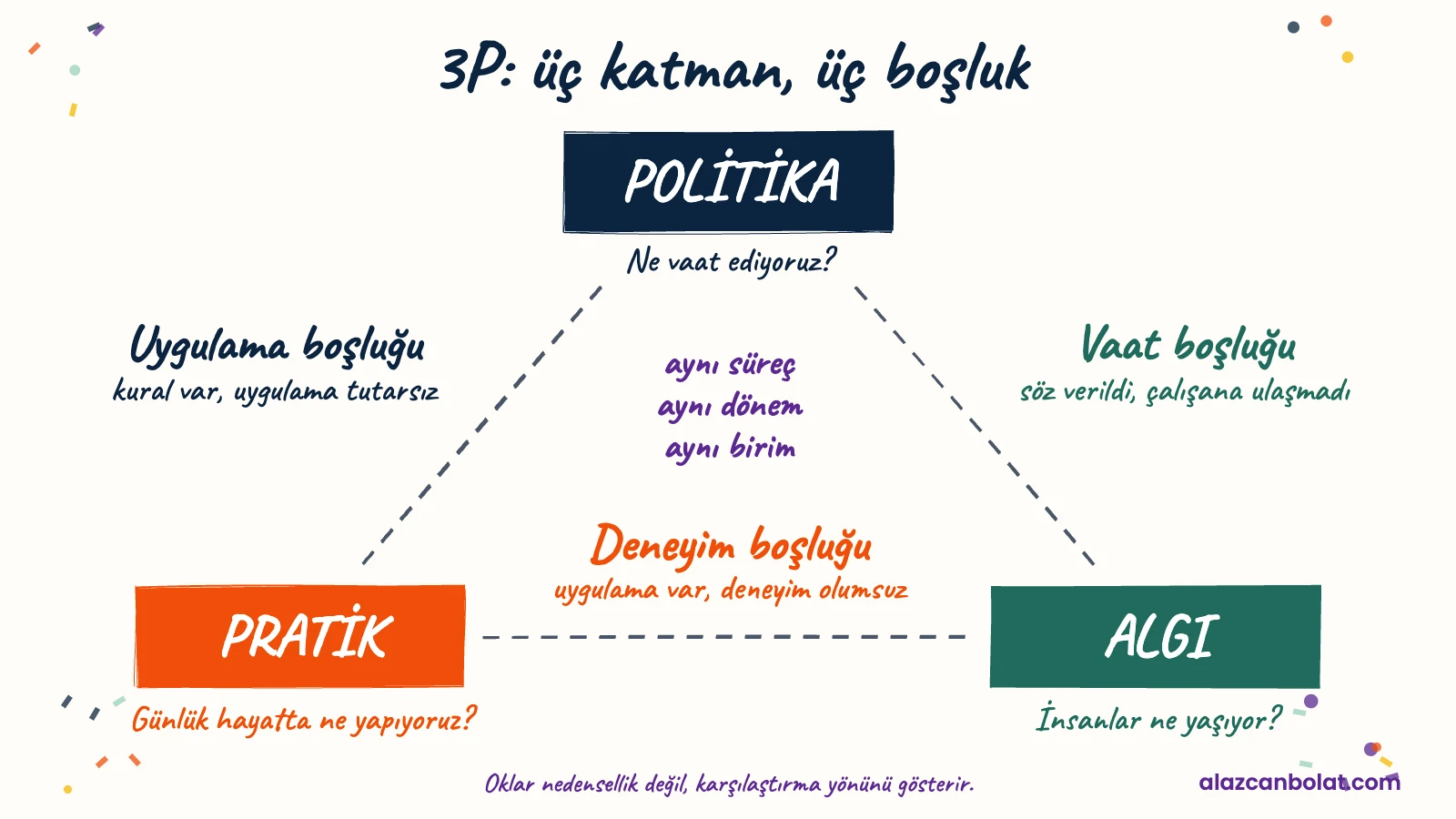
| Gap | Example | First direction of inquiry |
|---|---|---|
| Implementation gap (Policy–Practice) | There is an interview standard; managers change questions and scoring in their own way. | Ownership, skills, incentives and exception authority; embedding the form in the process |
| Experience gap (Practice–Perception) | Opinions are invited in meetings; employees feel excluded when they disagree. | Subsequent decisions and follow-up behaviour; response after an objection |
| Promise gap (Policy–Perception) | Equal development opportunity is announced; the night shift cannot reach the trainings. | Access route and real conditions of use; redesigning timing and channel |
Alignment and quality are not the same thing. If the rule is weak, practice is weak and the experience is negative, the three layers can be consistent with each other; there is no visible gap, but there is no inclusion either. That is why 3P looks at both the quality of each layer and the alignment between them. The directions of inquiry in the table are starting hypotheses, not conclusions.
Six employee experience areas
The three layers are applied with the same method to six areas of employee experience. The areas are not a maturity sequence and are not prerequisites for each other; in a first application, an organisation may go deeper into one or two areas within a single process. In each area the same question is asked: for whom is this experience possible, and for whom is it harder?
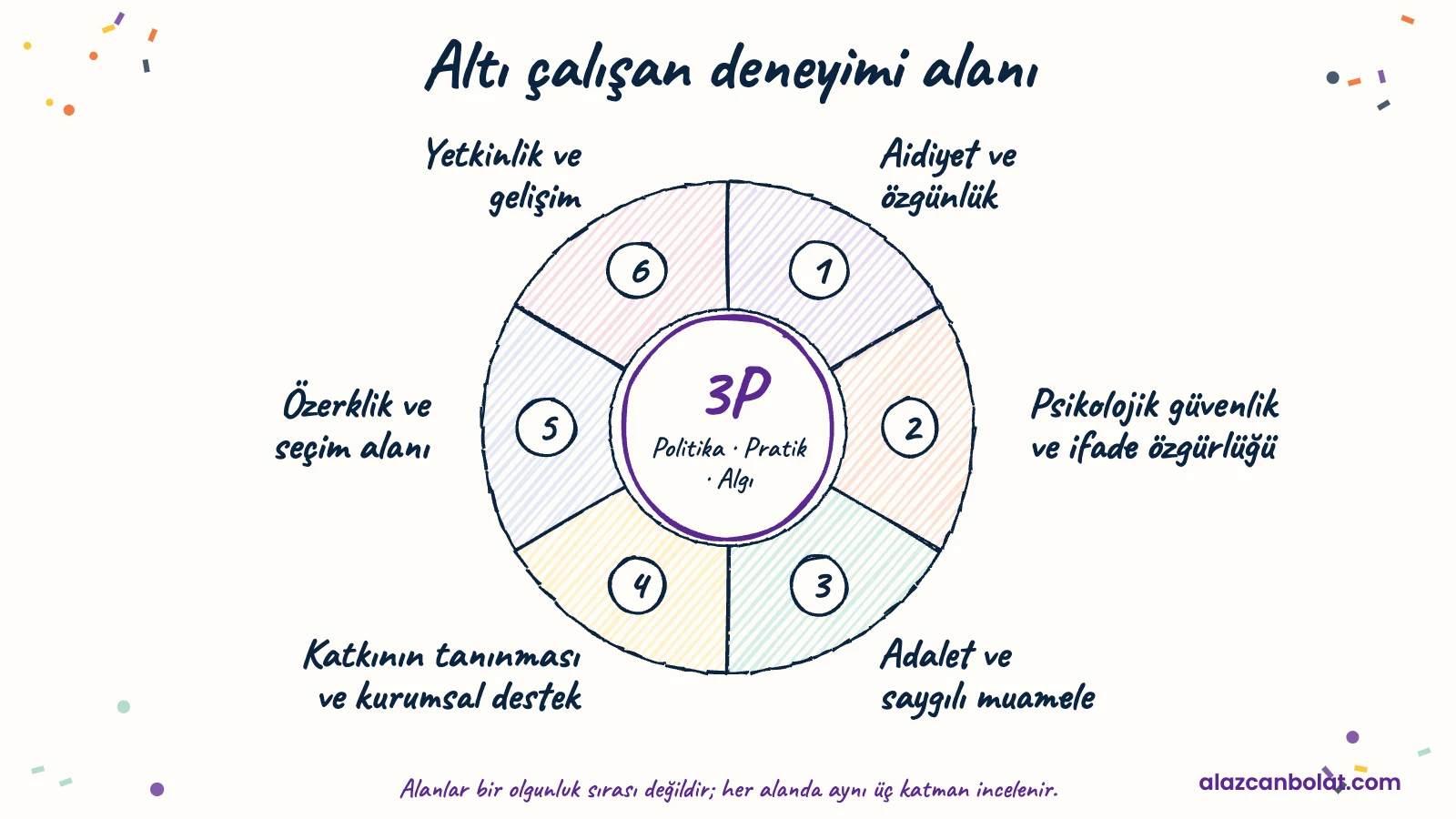
I can’t be myself here.
If I raise a problem, I’ll be harmed.
I don’t know how decisions are made.
My work goes unnoticed.
Every step needs approval.
I don’t have the information or tools to do my job.
The areas were chosen using the criteria of broad empirical support, conceptual definability and translatability into HR practice; meta-analyses were prioritised. This does not mean they are the “six strongest areas” in the literature, but that they form a practical synthesis with strong research support.
How is 3P used?
- Choose a process: for example the last promotion round, a recruitment shortlist or flexible working requests.
- Define the strained experience: in which area, and for whom?
- Collect three kinds of evidence for the same period: documents and process records (Policy), decision examples and observation (Practice), surveys and interviews (Perception).
- Pilot no more than two changes: attach an owner and a tracking indicator to each change; track the change in the process and its effect on employee experience separately.
You can find how I work with organisations and the outputs of the consulting process on the Inclusive Culture Consultancy page.
How the model emerged
3P iki kaynaktan beslendi. Birincisi saha: yıllardır farklı sektörlerde ve ülkelerde kurumlarla çalışırken aynı örüntüyü tekrar tekrar gördüm. Politika yazılıydı, eğitim verilmişti, ama çalışanın gündelik deneyimi farklı bir şey anlatıyordu. Padova Üniversitesi’ndeki yüksek lisans tezimde çeşitlilik eğitiminin kurumsal bağlılık ve algılanan kapsayıcılıkla ilişkisine bakarken de aynı soru büyüdü: Eğitimin dokunamadığı kararlar, toplantılar ve fırsat dağılımı ne olacak? İkincisi literatür: kapsayıcılık, psikolojik güvenlik, örgütsel adalet, algılanan örgütsel destek ve politika ile uygulama arasındaki ayrışma üzerine yerleşik araştırmalar. 3P yeni bir kavram önermiyor; var olan kavramları aynı süreçte üç tür kanıtla birlikte okumayı ve bulguyu bir süreç değişikliğine bağlamayı öneriyor.
The literature it draws on
The studies below form the model’s conceptual foundations. These sources support the related concepts and findings; they do not validate the integrated 3P model.
- Inclusion and belonging: Shore et al. (2011) define inclusion as the joint fulfilment of belonging and uniqueness; Chung et al. (2020) test a work group inclusion scale; Nishii (2013) examines the effect of an inclusion climate.
- Psychological safety: Edmondson (1999) and the meta-analysis by Frazier et al. (2017).
- Organisational justice: Colquitt (2001) four-dimensional justice structure; Colquitt et al. (2001) meta-analysis.
- Support and basic needs: Kurtessis et al. (2017) perceived organisational support meta-analysis; Van den Broeck et al. (2016) needs for autonomy, competence and relatedness at work.
- Decoupling between policy and practice: Meyer and Rowan (1977) the ceremonial function of formal structure; Bromley and Powell (2012) policy–practice and means–ends decoupling; Bowen and Ostroff (2004) the “strength” of the HR system; Wright and Nishii (2007) the distinction between intended, actual and perceived HR practices.
- Concepts adjacent to the promise gap: Rousseau (1995) psychological contract; Zhao et al. (2007) contract breach meta-analysis; Simons (2002) behavioural integrity.
Limits of the model
- 3P is not a scale, a certification standard, an individual psychological assessment or a legal audit.
- The arrows in the diagram do not express validated causality; the triad is a way of reading.
- It is not claimed that the six areas together form a validated six-factor structure.
- The question sets and forms used in practice are listening and project management tools; they have not been psychometrically validated.
- The aim of an application is not to judge whether an organisation “is inclusive”, but to improve specific conditions in a specific process.
The model continues to be developed with feedback from organisational applications.
Do rules, practice and experience say the same thing in your organisation?
In a 30-minute discovery call, let’s choose your priority process together and discuss where to start with 3P.
References
- Bowen, D. E. and Ostroff, C. (2004). Understanding HRM–firm performance linkages: The role of the “strength” of the HRM system. Academy of Management Review, 29(2), 203–221. https://doi.org/10.5465/amr.2004.12736076
- Bromley, P. and Powell, W. W. (2012). From smoke and mirrors to walking the talk: Decoupling in the contemporary world. Academy of Management Annals, 6(1), 483–530.
- Canbolat, A. H. (2024). The impact of diversity training on employee commitment: A comparative study of companies in Turkey with and without training, and the moderating role of age [Master’s thesis]. Università degli Studi di Padova. https://hdl.handle.net/20.500.12608/75362
- Chung, B. G., Ehrhart, K. H., Shore, L. M., Randel, A. E., Dean, M. A. and Kedharnath, U. (2020). Work group inclusion: Test of a scale and model. Group & Organization Management, 45(1), 75–102. https://doi.org/10.1177/1059601119839858
- Colquitt, J. A. (2001). On the dimensionality of organizational justice: A construct validation of a measure. Journal of Applied Psychology, 86(3), 386–400. https://doi.org/10.1037/0021-9010.86.3.386
- Colquitt, J. A., Conlon, D. E., Wesson, M. J., Porter, C. O. L. H. and Ng, K. Y. (2001). Justice at the millennium: A meta-analytic review of 25 years of organizational justice research. Journal of Applied Psychology, 86(3), 425–445. https://doi.org/10.1037/0021-9010.86.3.425
- Edmondson, A. (1999). Psychological safety and learning behavior in work teams. Administrative Science Quarterly, 44(2), 350–383. https://doi.org/10.2307/2666999
- Frazier, M. L., Fainshmidt, S., Klinger, R. L., Pezeshkan, A. and Vracheva, V. (2017). Psychological safety: A meta-analytic review and extension. Personnel Psychology, 70(1), 113–165. https://doi.org/10.1111/peps.12183
- Kurtessis, J. N., Eisenberger, R., Ford, M. T., Buffardi, L. C., Stewart, K. A. and Adis, C. S. (2017). Perceived organizational support: A meta-analytic evaluation of organizational support theory. Journal of Management, 43(6), 1854–1884. https://doi.org/10.1177/0149206315575554
- Meyer, J. W. and Rowan, B. (1977). Institutionalized organizations: Formal structure as myth and ceremony. American Journal of Sociology, 83(2), 340–363. https://doi.org/10.1086/226550
- Nishii, L. H. (2013). The benefits of climate for inclusion for gender-diverse groups. Academy of Management Journal, 56(6), 1754–1774. https://doi.org/10.5465/amj.2009.0823
- Rousseau, D. M. (1995). Psychological contracts in organizations: Understanding written and unwritten agreements. Sage.
- Shore, L. M., Randel, A. E., Chung, B. G., Dean, M. A., Ehrhart, K. H. and Singh, G. (2011). Inclusion and diversity in work groups: A review and model for future research. Journal of Management, 37(4), 1262–1289. https://doi.org/10.1177/0149206310385943
- Simons, T. (2002). Behavioral integrity: The perceived alignment between managers’ words and deeds as a research focus. Organization Science, 13(1), 18–35.
- Van den Broeck, A., Ferris, D. L., Chang, C.-H. and Rosen, C. C. (2016). A review of self-determination theory’s basic psychological needs at work. Journal of Management, 42(5), 1195–1229. https://doi.org/10.1177/0149206316632058
- Wright, P. M. and Nishii, L. H. (2007). Strategic HRM and organizational behavior: Integrating multiple levels of analysis (CAHRS Working Paper 07-03). Cornell University, Center for Advanced Human Resource Studies.
- Zhao, H., Wayne, S. J., Glibkowski, B. C. and Bravo, J. (2007). The impact of psychological contract breach on work-related outcomes: A meta-analysis. Personnel Psychology, 60(3), 647–680.
Author: Alaz Han Canbolat, Intercultural Psychologist · Diversity and Inclusion Expert · Learning Ecosystem Designer. About me