Status Beliefs Theory: Who Seems “Naturally” Competent?
This is where a key theory comes in: Status Beliefs Theory (Ridgeway, 2001).In society, some groups are perceived as more “competent” and as having more “leadership potential” without any objective data.
It’s 2018; back then I am a biological woman. I am running for president of a national student organisation. My CV, skills, academic record, languages and NGO background put me several notches above the male candidate running against me. There is just one difference between us: because I am a woman, I can’t travel freely between cities to build in-person connections with the organisation’s members, because every trip to another city or abroad means battling my family’s norms, starting a month in advance. Oh, and he is also 13–15 cm taller than me. Thankfully,Zeynep Aycan , my professor, and many of my teachers from academia and the field mentored me through my candidacy at the time. The only reason I could see for not winning was that the other candidate made very good use of the connections he had built. With the fire of youth inside me, it took me years to understand what had happened, and many of my insights came from Professor Aycan’s research and writing. All of us who voted back then have grown up and changed, and we have talked a lot about that election since. I realised that the whole issue was never my performance, but how little I fitted the organisation’s “ideal president” template, and that I would never want to fit it.
Sociologist Joan Ackersays: “Organisations are not gender-neutral.” Even what we call “professionalism” is itself a particular norm. A profile that is controlled, distant, carries no emotional load and moves through an uninterrupted career usually gets labelled “professional”. This definition of the “ideal worker” puts women one goal down from the start. Even if the system appears to treat everyone equally, the rules were written to male norms.
Glass Cliff: When Do Women Become Leaders?
We all know the “glass ceiling” by now: the invisible barriers that block women’s rise through the organisational hierarchy.. But there is a less familiar concept: Glass Cliff – introduced by Michelle Ryan and Alex Haslam in 2005, it describes women being brought into leadership in times of crisis. According to this theory, women are often appointed to leadership positions not when things are going well, but in moments of crisis. So they become leaders… If they fail: “It was never going to work.” If they succeed: “She got lucky.” This shows that inequality is not only about access, but also about conditions too. In short, the glass ceiling blocks the climb to the top, while the glass cliff pushes those who make it there towards the edge.
Working Life in Türkiye
When we look at working life in Türkiye, we see these theories play out very clearly. Research shows that women can remain systematically disadvantaged in hiring, promotion and pay. But this is usually explained not as open discrimination, but with reasons such as “fit”, “timing” or “organisational needs”. In other words, inequality works indirectly rather than directly, which makes it harder to notice and harder to discuss. So, is nobody doing great things? Of course they are, and we watch them with pride and congratulate them wholeheartedly: those investing to increase the share of women in their workforce, those supporting women and contributing to employment.. Hats off to all of them. Their efforts are our biggest hope for bringing those 134 years forward.
(Spoiler: the next series will be about these organisations and their projects.)
So How Does This Change?
What we’ve covered so far is a bit heavy, but the solution is not as complicated as we think. Equality starts in everyday practices before grand strategies.
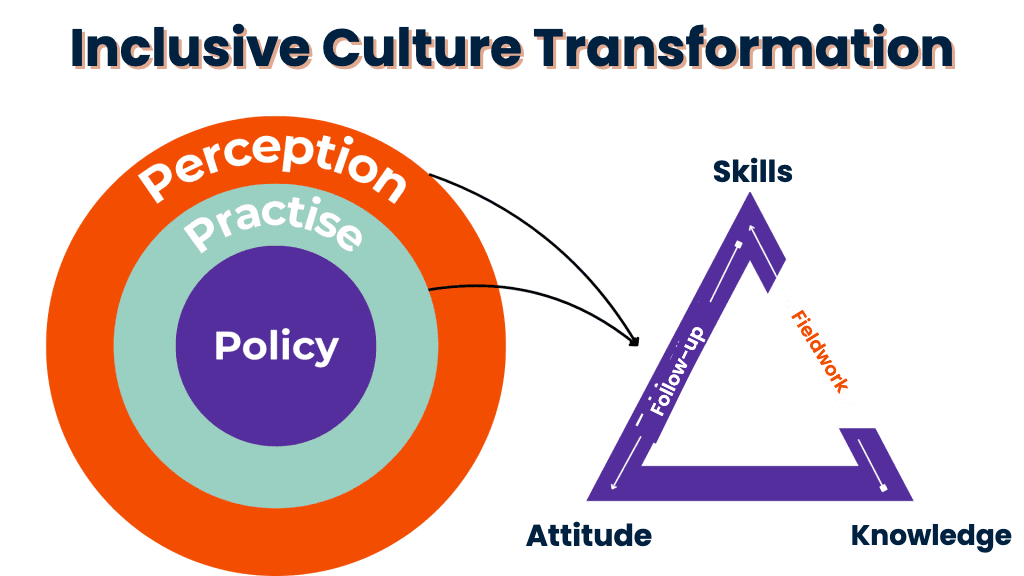
For inclusion to be sustainable in organisations, it needs to turn into three things:
- Policy (rules),
- Practice(habits)
- Perception (climate and perception)