Signature Programme · J-EDI Master

Develop ambassadors who don’t just talk about inclusion, but make it visible in everyday work.

J-EDI Master is a 2–3 day experiential programme I designed for in-house DEI ambassadors and D&I leaders. Participants start by turning inward and move on to seeing their team and the organisation’s system.

J-EDI: four core concepts

J

Justice

Are processes and outcomes fair for everyone?

E

Equity

What support do different needs require?

D

Diversity

Who is here, and which experiences shape decisions?

I

Inclusion

Can everyone belong and still be themselves?

2–3 daysIn person, experiential
AmbassadorsDEI ambassadors and D&I leaders
3PPolicy, Practice, Perception

300+ organisations and projects in 60+ countries

Organisations across automotive, logistics, pharmaceuticals, retail, education and luxury consumer goods, as well as universities and civil society organisations

Alumil logosuAjinomoto logosuPapillon Hotels logosuMAN logosuDHL logosuToyota logosuKoç Holding ve Aygaz logosuBioMarin logosuRecordati logosuEnerjiSA logosuSardunya Catering logosuLesaffre logosuRönesans Holding logosuPVH Corp. logosuCalvin Klein logosuTommy Hilfiger logosuBulgari logosuL’Oréal logosuEstée Lauder logosuSevil Smile logosuIC Group Hotels logosuKariyer.net logosuÖzyeğin Üniversitesi logosuAG Tohum logosuAkdeniz Üniversitesi logosuNN Hayat ve Emeklilik logosu
Who It’s For

This programme may be right for you if…

You have built an ambassador network, but roles are unclear

There are volunteers and motivation is high, but what an ambassador does and doesn’t do is not defined.

Ambassadors have the intention but not the tools

They don’t know how to act when they notice an unheard voice in a meeting or when someone shares an incident.

Inclusion has remained HR’s job alone

Programmes come from HR, but no one in the teams owns them or carries them into daily work.

Awareness is there, behaviour hasn’t changed

Trainings received good feedback, but there is no visible effect in meetings, decisions or team rhythms.

Programme Flow

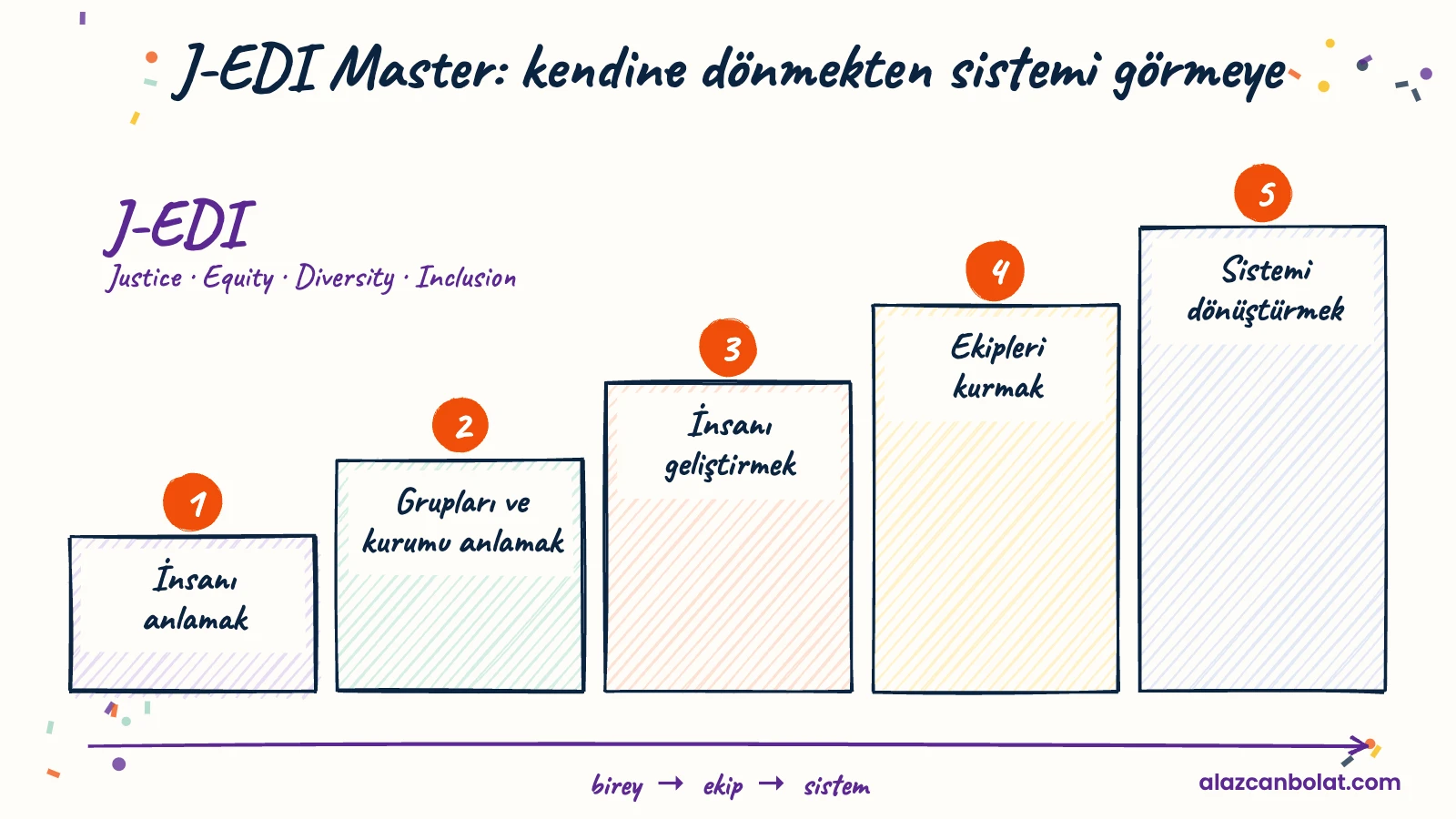
From turning inward to seeing the system, in five stages.

We teach inclusion by letting people experience it, not by lecturing. At each stage we first experience, then conceptualise and finally carry it into work.

1

Understanding people

Mental schemas, bias and assumptions. Seeing, from our own experience, which assumptions our choices rest on.

2

Understanding groups and the organisation

Us and them, bystanding and silence, visible and invisible diversity. A shared J-EDI language.

3

Developing people

Allyship: reassuring, learning and advocating behaviours. Saying “Would you like to finish?”

4

Building teams

The difference between belonging and psychological safety. A five-point psychological safety agreement with the team.

5

Transforming the system

Choosing a process with 3P and checking whether the rule, the practice and the experience say the same thing.

J-EDI Master programının beş durağı: insanı anlamak, grupları ve kurumu anlamak, insanı geliştirmek, ekipleri kurmak, sistemi dönüştürmek.
The Ambassador’s Role

Not the person with every answer, but the person who makes room.

Being an ambassador means being willing to be curious about people’s experiences, to question your own assumptions and to turn what you learn into behaviour. The role’s boundary protects both the ambassador and the employee.

Not the ambassador’s job

  • Investigating sensitive complaints
  • Assessing or diagnosing employees
  • Accessing confidential files
  • Carrying inclusion alone

What an ambassador does

  • Observes everyday practices and gathers questions
  • Makes room for unheard voices in meetings
  • Listens when an incident is shared and points to the right authorised channel
  • Takes part in improvement design and pilots
Concrete Outcomes

What participants leave with

Deliverables

The ambassador’s toolkit

  • A short J-EDI glossary the team uses with the same meaning
  • An ambassador role card: what they do and don’t do
  • A five-point psychological safety agreement
  • A 3P evidence list and first action proposal for a chosen process
  • One observable behaviour for the 30 days after the training
Extended Journey · Optional

For organisations that want lasting impact

  • Online learning circles
  • Six weeks of microlearning
  • Short readings and small tasks
  • A dashboard that makes progress visible
  • Gamification

The extended journey is based on the 4-Layer Learning Ecosystem approach.

Measurement

We track impact not by satisfaction, but across four layers .

İlk üç katman, 3P Inclusive Culture Model™'nin üç kanıt düzeyidir.

01

Policy

Rules, scope, roles and review cycle.

02

Practice

Behaviour, use and process consistency.

03

Perception

The experience of fairness, trust, voice, belonging and access.

04

Outcome

People and business outcomes.

“Inclusion is most visible not in the strategy document, but in the Tuesday 10 a.m. meeting.”

The starting point of J-EDI Master
From the Field

In every organisation, tailored to its structure.

J-EDI Master has been delivered with DEI ambassadors and D&I leaders of international organisations operating in the automotive and logistics sectors in Türkiye. In each organisation, the programme is adapted to its policies, ambassador structure and priorities.

Sources the programme draws on
  • Edmondson, A. (1999). Psychological safety and learning behavior in work teams. Administrative Science Quarterly, 44(2), 350–383.
  • Edmondson, A. C. (2019). The fearless organization. Wiley.
  • Kolb, D. A. (1984). Experiential learning: Experience as the source of learning and development. Prentice Hall.
  • Shore, L. M. et al. (2011). Inclusion and diversity in work groups: A review and model for future research. Journal of Management, 37(4), 1262–1289.

Let’s plan a J-EDI Master programme for your organisation’s ambassadors.

In a 30-minute discovery call, let’s discuss your ambassador structure, participant profile and the behaviours you are aiming for, and tailor the programme accordingly.

Book a Discovery Call